
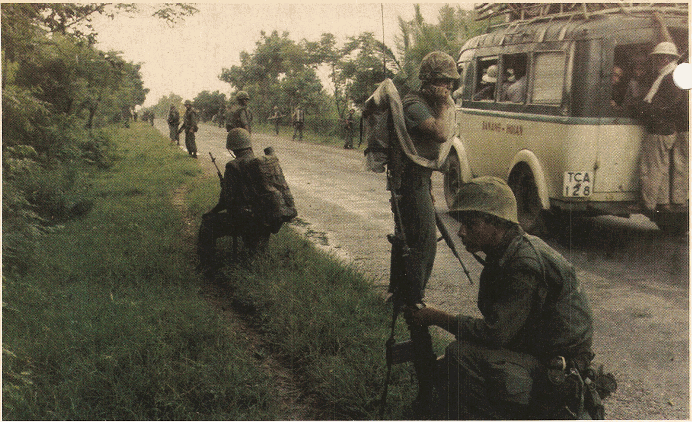
A Marine patrol moves up a local highway, passed by a civilian bus. In accordance with General Westmoreland's
"Letter of Instruction," the Marines were initially restricted to defensive and reactive activities around Chu Lai and DaNang.
Peatross opted for a two-prong attack. The 2nd Battalion, 4th Marines, given the sobriquet "The Magnificent Bastards" because of their valor in World War II, would land by helicopter, while the 3rd Battalion, 3rd Marines, would participate in an amphibious assault, hemming the Viet Cong between them.land by helicopter, while the 3rd Battalion, 3rd Marines, would participate in an amphibious assault, hemming the Viet Cong between them. The former Raider had settled on the dual sea and air thrust due to the scarcity of helicopters and ground transportation. Highway 1, the lone thoroughfare, did not come closer than 12,000 meters to the Van Tuong village complex. Trucks, amphibious tractors and other vehicles would be forced to travel a series of back roads the drivers would be unfamiliar with. An amphibious assault would eliminate these supply nightmares since the provisions would be waiting just offshore. Lastly, and most important, Peatross wanted to keep his one trump card: the element of surprise. No one, with the exception of General Thi and Brig. Gen. Hoang Xuan Lam of the South Vietnamese Army, was briefed on the operation.
Secrecy was adamantly maintained. Over a two-day period, orders were issued and units were assembled for the first regimental-size operation since the Korean War. The mission, originally dubbed SATELLITE, was mistyped when a generator failed, causing a power failure. The attack order was finished by candlelight, accounting for the new name, STARLITE. Too late to change once the error was discovered, it remained. Thus, Operation STARLITE was born.
In Da Nang, General Walt requested, and got, approval for a third battalion as floating reserve for the duration of the operation from Admiral Ulysses S. Grant Sharp, Commander in Chief, Pacific. This Special Landing Force (SLF) was located at Subic Bay, 720 miles away, and was alerted and given to Walt. Based upon the transit time to travel to the area, August 18 was chosen as D-day.
Meanwhile, Peatross, together with Lt. Co!. Joseph R. "Bull" Fisher, CO of 2/4, and Lt. Co!. Joseph E. Muir, CO of 3/3, undertook an aerial reconnaissance of the Van Tuong Peninsula to select the landing sites for STARLITE. "[We] observed that the proposed battleground was mostly rolling country;' Peatross would note, "about three-quarters cultivated, and elsewhere there was thick scrub from six to 100 feet ... and there were few rice paddies. The beaches were sandy, with dunes in some places as far inland as 200 yards." Also, several ham-lets dotted the countryside encompassed by hedgerows and dry crop sections in the 10-square mile objective.
Returning to Chu Lai, the three officers decided the amphibious landing site to be the southerly stretch north of the coastal village of An Cuong No. 1. It was designated GREEN BEACH and Muir's Marines were picked for the seaborne lunge. Fisher's men drew the helicopter assault. Three LZs (Landing Zones) were chosen and named, appropriately enough: RED, WHITE and BLUE. They were approximately five miles east of Route 1 and roughly one mile inland from the coast. Forming a type of arch, the three LZs were of equal distance apart. LZ BLUE, about 2,000 meters west of GREEN BEACH, was the southernmost of the three. LZ WHITE was 2,000 meters north of it and LZ RED was 2,000 meters north of WHITE. From this half-circle, the advancing leathernecks could move east, trapping the enemy.
Another factor in the Marines' favor was the timely arrival of the ships of Amphibious Squadron-7 (PHlBRON-7), unloading the members of BLT 117 and BLT 3/9. Colonel Peatross immediately contacted Captain W.R. McKinney, squadron commander, and acquainted him with the strategy. Without delay, McKinney and his staff traveled to Chu Lai to confer with the Marine command. From under a tent, erected on the beach to protect them from the scorching heat, final preparations were made for STARLITE. Fortunately, the Underwater Demolition Teams (UDT) had cleared the landing beaches in May when the Marines first arrived at Chu Lai, and the task did not have to be repeated.
The plan was relatively simple. It called for Company, K 3/3, to set up a blocking position north of GREEN BEACH and seal off the Viet Cong's overland escape route. At 0630, the remainder of 3/3 would hit the beach and move inland. As this was transpiring, the "choppers" of HMM (Helicopter Marine Medium)
For 15 minutes, air and artillery pounded the beach and the helicopter LZs. At H-hour, 0630, the preparatory bombardment ceased and Muir's Marines scrambled ashore. Within minutes after racing across the wet, sandy ground, the beachhead was secured and the riflemen fanned out and pushed towards the west. Company I on the left flank and Company K on the right proceeded cautiously with Company L in battalion reserve. As Kilo Company groped its way in a northeasterly direction, it met harassing fire to its right. As two platoons moved to erase the threat, the other seized the the northern portion of An Cuong No. 1. India Company kept its westerly movement towards An Cuong No.2 to merge itself with Hotel Company 2/4. As the two rifle companies drove forward, Lima 3/3 established beach security, with Peatross setting up his headquarters with Muir. Tanks and Ontos (tracked vehicles mounted with six 106mm recoilless rifles), trudged through the slurry mixture of sand and water and sped ahead to give support to the infantry. The amphibious part of the attack had gone without a hitch.
Unfortunately, the same could not be said for the helo assault. Company G, landing at LZ RED, quickly tied in with Mike 3/3, further closing the cordon that guarded the area. Company E, 2/4, together with Fisher's staff, touched down on LZ WHITE and pressed straight ahead. Soon, the infantrymen ran into stiff opposition from Viet Cong entrenched on a ridgeline that traversed east and northeast of the LZ. After some heavy fighting, the leathernecks dislodged the insurgents from the hilly terrain. At one point, Echo Company, 2/4, observed a large group of Viet Cong, estimated to be about 100 strong, moving in the open.
While jet aircraft from VMFA513 and VMFA342 pummeled the slopes and summit of Hill 43, the "grunts" prepared themselves to attack the small knoll. As soon as the planes peeled off, the riflemen began their frontal assault to push the Viet Cong off the rise. Coupled with tanks and continued close air sorties, the gyrenes scattered their pajama-clad foe from their emplacements. Numerous enemy bodies were strewn throughout the zone of action, and Jenkins' men collected over 40 weapons.
Forced to halt their advance while the Skyhawks and Phantoms were hammering the Communists on Hill 43, the leader of Company I, 3/3, Captain Bruce D. Webb, radioed for permission to move on An Cuong No.2 and make contact with Company H, 2/4. An Cuong No.2 was a heavily fortified hamlet and Webb's unit was receiving automatic weapons fire from the ville. The terrain was ideal for an ambush as "An Cuong No.2, itself, consisted of 25-30 huts, fighting holes, and camouflaged trench lines connected by a system of interlocking tunnels." Given the go-ahead by Peatross, India Company probed the first few hootches when a grenade was tossed at the Marines. Killed in the explosion was Webb. For his leadership, he was awarded a Navy Cross posthumously. Without warning, several mortar rounds fell among the infantrymen inflicting further casualties. Taking charge, Lieutenant Richard M. Purnell resumed the attack and overran the tiny village killing 50 of the enemy. Upon its completion, Purnell was told to wheel his company around and reinforce Company K, 3/3, hotly engaged with the Viet Cong near Phase Line BANANA, 2,000 meters to the northeast.
361 and 261 would transport 2/4 to their appropriate LZs to start their eastward movement. The leathernecks would sweep the Van Tuong village complex all the way to the Phouc Thuan Peninsula. Artillery support was to be provided by batteries at Chu Lai while naval gunfire would come from two destroyers: the Orleck (DD-886), the Prichett (D0D-561); and the cruiser Galveston (CLG-3). Pilots from MAGs (Marine Air Groups) 11, 12 and 16 were also told of their vital role in the operation: close air support.
All the pieces were in place. Peatross would comment afterward: "There just wasn't enough time for anyone to bring up any problems." STARLlTE was under way.
On the morning of August 17, 1965, Lt. Co!. James P. Kelly's 1st Battalion, 7th Marines, assumed the defensive responsibilities of the Chu Lai outpost, as Company M 3/3 boarded L VTs bound for the Trung Phan Peninsula. Once ashore, Mike Company, without arousing any suspicion, marched four miles to its blocking area near the Tra Bong River. Encountering only intermittent sniper fire, the infantrymen reached their destination by dawn on the eighteenth, and dug in.
While Mike Company detached itself for its mission, the rest of 3/3, including Colonel Peatross and his regimental staff, embarked upon the task force assigned to them: the Bayfield (APA33), the Cabildo (LSD-16) and the Vernon County (LST-1161). Also two LCUs (Landing Craft, Utility) sailed independently from the flotilla, carrying five M-48 tanks and three M-67 flame-thrower tanks, and timed their arrival with that of the troop transports. By nightfall, the vessels were steaming out to the South China Sea heading east. Once clear of Chu Lai, the convoy altered its course to southwest, to deceive any Viet Cong spies that were known to be disguised as fishermen on sampans in the harbor. By 0500, the transports were joined by the Orleck and the Galveston in Nho Na Bay near the Van Tuong Peninsula. The Prichett would be delayed until D+1, but the Marines felt they had sufficient firepower to carry the amphibious attack.
In the gray, predawn light of August 18, 1965, "Bull" Fisher's Marines assembled to await the arrival of the helicopters that would lift them to their objective. Suddenly, in the distance, the all-too-familiar swishing sounds of the chopper blades could be heard as they cut the humid, oppressive tropical air like a knife. As the UH-34D Sikorsky aircraft touched ground, the leathernecks leaped aboard. Gunnery Sergeant Victor Nunez of Weapons Platoon, recalls: "The flight to the Peninsula didn't take too long, 10 minutes maybe. I sat down across from the center hatch and remember observing the door gunner checking his weapon, so I decided to double check my own M-14 and grenades before we hit the LZ."
At 0615, the serene setting was unexpectedly shattered by the screeching 155mm shells of Battery K, 4th Battalion, 12th Marines, from their concealed positions north of the lra Bong River impacting near the LZs RED, WHITE and BLUE. Overhead the roar of 20 Marine A4s and F-4s from MAG-11 and MAG-12 pierced the air as the jets dropped 18 tons of bombs, and canisters of napalm that billowed into huge fireballs. The beach area was strafed by additional fixed-wing aircraft with 20mm cannon fire. No "snake and nape" was released here due to the close proximity of An Cuong No. 1 to the landing location.
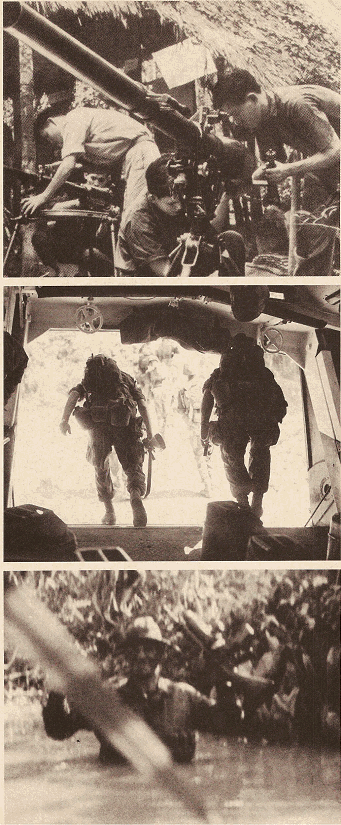
TOP: By 1965, the Viet Cong were equipped with such potent weaponry as American-built 75mm recoilless rifles. In 1963 and 1964, some 22,000 American-made weapons had been captured or otherwise found their way into Communist hands. MIDDLE: Troops of H Co., 2nd Battalion, 3rd Marines, leave an LVT after crossing the Da De River, to conduct a sweep-and-clear operation in Pho Nam Thuong, 15 miles northwest of DaNang, on Aug. 13, 1965. ABOVE: As Operation STARLITE gets under way, a Marine wades into it-and the river-above the waist.

TOP: As contact is made with the Viet Cong and those entrenched in better-prepared positions elect to hold, a 105mm gun of the 3rd Marines pours in fire support at a rate of three rounds per minute. ABOVE: A Marine drags a dead Viet Cong past a woman and her child during a village sweep near Chu Lai in 1965.
Taking advantage of this opportunity, a fire mission was requested and a 107mm "Howtar" Battery (4.2-inch mortars mounted on a 75mm, howitzer frame; hence the nickname of "Howtar") was flown to Mike 3/3's location to carry out the order. In a matter of minutes, over 90 Viet Cong lay dead. Colonel Fisher himself was heli-lifted over the area and confirmed the body count.
As Companies E and C were enjoying substantial gains, Company H, 2/4, set down on LZ BLUE and formed a hasty defense. The surroundings were a hodgepodge of rice paddies, streams, hedgerows, and small wooded thickets approximately one square kilometer in size and bordered by the villages of An Thoi No.2 on the north, Nam Yen No.3 on the south and An Cuong No. 2 to the east. At first everything appeared normal in the tranquil atmosphere, but as the second wave of choppers dropped off the Marines, the sharp crack of the Viet Cong snipers permeated the air.
Lance Corporal Jimmy Brooks, a tall, amiable Southerner they called "The Buzzard;' tumbled off the noisy "bird.” Thinking he had tripped, a Marine rushed to his aid. As the individual cradled him in his arms, he noticed a gaping hole where the bullet had exited his back. Brooks later died. There was scurrying for cover as the volume of fire grew in intensity. A door gunner had his jaw ripped open. One sergeant caught a round in the throat. Captain Howard B. Henry, a pilot from HMM-361, later recalled: "You just have to close your eyes and drop down to the deck."
Unknown to the Marines, they had stumbled upon the headquarters of the 60th VC Battalion! Hill 43, a small rise to the east of LZ BLUE, seemed to be the likely source of the painfully accurate fire. Three UH-1B Huey gunships swung into action against the enemy pinning them down.
First Lieutenant Homer K. Jenkins, Hotel Company Commander, was in the dark as to the size of the enemy unit he was facing. Consequently, he dispatched one platoon to take Hill 43 and the rest of the company to proceed to Nam Yen No.3 and capture it. However, both assaults soon came to a standstill. Realizing the Viet Cong were here in great strength, Jenkins ordered his two platoons at Nam Yen No. 3 to backtrack to Hill 43 for a concentrated effort at securing the enemy stronghold.
